Why do wrinkles appear, and why do they not all mean the same thing?
When someone says “I am starting to look more wrinkled,” they may be describing very different changes. One line may appear only when smiling or raising the eyebrows; another may have started as an expression line and now remain visible with the face relaxed; and a deeper fold may become more noticeable because the support or position of the surrounding tissues has changed.
That is why this page does not try to give one solution for “wrinkles.” Its purpose is to help you recognize what kind of line you are seeing, when it appears and where it is located. That classification is what later allows you to move to a specific concern page or treatment without treating every line as though it were the same.
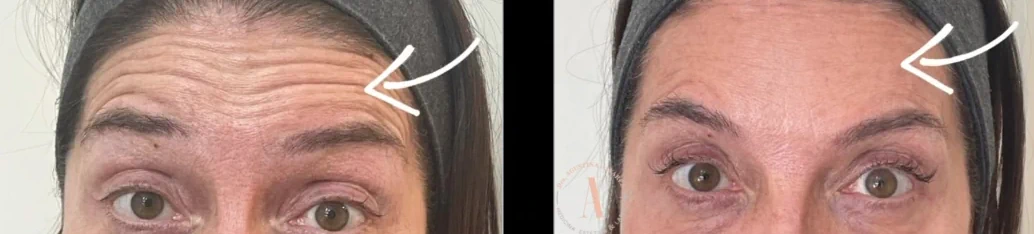
What is the difference between expression lines, dynamic wrinkles and wrinkles at rest?
Expression lines are folds that appear with normal facial movement. Smiling creases the eye area, raising the eyebrows folds the forehead, and frowning or pursing the lips changes the skin around the mouth. When a line appears during expression and disappears completely when the face relaxes, the component is predominantly dynamic.
Over time, repeated movement can combine with changes in elasticity, collagen and skin quality. The same line may then take longer to smooth out or remain visible at rest. At that point it is no longer only a matter of “moving the face a lot”: a more persistent mark has developed in the skin.
This distinction is central because a line produced mainly by movement is not approached in the same way as a fixed mark or a fold related to loss of support.
What type of wrinkle do I have based on where it appears?
Location helps organize the problem. These five areas have their own pages because the questions, anatomy and path toward treatment are different:
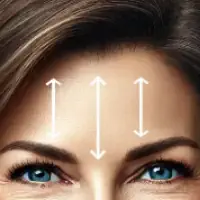
- Forehead: if horizontal lines appear mainly when raising the eyebrows or are already visible at rest, continue to forehead wrinkles and expression lines.
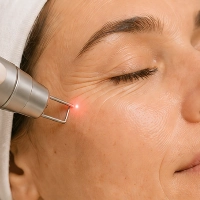
- Outer eye area: if lines appear when smiling or squinting, the dedicated page is crow’s feet.
- Above the upper lip: if there are vertical lines or so-called “smoker’s lines,” continue to upper-lip or perioral lines.
- From the corner of the mouth toward the chin: if the expression looks sad or the corners of the mouth appear lower, continue to marionette lines.
- From the nose toward the mouth: if the fold separates the cheek from the perioral area, continue to the nasolabial fold.
The purpose of this map is not to give every line a technical label. It is to prevent a broad search such as “I want to get rid of my wrinkles” from mixing together problems that require different assessments.
What if pigmentation and wrinkles appear at the same time?
Pigmentation and wrinkles can coexist because some factors—such as accumulated sun exposure and age-related skin changes—affect more than one characteristic of the face. But they are not the same problem: pigmentation is a color change, while a wrinkle is a line, fold or change in surface contour.
If color, dark areas or uneven tone are what concern you most, the skin pigmentation page develops that pathway. Here, the priority is identifying what type of line you are seeing and where on the face it appears.
Why can I have expression lines or wrinkles when I am still young?
Having lines during expression does not necessarily mean a face has aged prematurely. Some people are highly expressive, raise their eyebrows strongly, smile broadly or have anatomy that creates visible folds from a young age. If those lines disappear when the face relaxes, they may simply be part of normal expression.
Genetics, accumulated sun exposure and individual skin characteristics also matter. Age alone therefore tells us very little. It is more useful to ask whether the line has changed, whether it now remains at rest, and whether it is appearing in one area or several.
Why does an expression line eventually remain visible even when I stop making the expression?
Younger skin generally recovers its shape more easily after folding. Over time that ability decreases, and repeated folds can leave a progressively more persistent mark. It does not happen overnight: many people first notice the line in certain lighting, then see that it takes longer to disappear, and eventually recognize it even with the face relaxed.
When that happens, movement may still contribute, but it is no longer the only component. Skin quality matters too. That combination explains why an established wrinkle may require a different strategy from a purely dynamic line.
What affects wrinkles besides age and facial expressions?
Accumulated sun exposure is one of the factors that most changes skin quality over time. Genetics, smoking, skin thickness, progressive loss of elasticity and hormonal changes that can affect hydration and collagen also play a role. None acts in isolation or produces the same pattern in every person.
When lines are accompanied by color changes, pigmentation or texture changes, it is useful to separate the wrinkle component from the pigmentation problem. The skin pigmentation guide covers that part of the picture without turning “pigmentation and wrinkles” into one single condition.
Can dry skin, not drinking enough water or poor sleep cause wrinkles?
Dehydrated skin can look duller and make fine lines more noticeable. Poor sleep can also temporarily change the appearance of the face and make certain shadows or folds stand out more. That is different from suddenly creating a structural wrinkle.
Drinking water is important for general health, but a wrinkle produced by repeated muscle contraction or a line that has already become established does not selectively disappear by increasing water intake. It helps to distinguish factors that make lines look more visible from the mechanisms that actually create them.
Can a face look more wrinkled even when the main problem is not the skin?
Yes. Some folds become more visible because tissue support has changed, not because a simple superficial line has formed. When someone feels that “the face has fallen,” “lost volume,” or that certain folds deepened together with descent of the cheeks or corners of the mouth, the whole face should be considered.
That is why the nasolabial fold and marionette lines are assessed separately: they describe different changes. The line is visible, but the cause may be related to support in the midface or lower face. There may also be a broader pattern of facial aging or facial laxity.
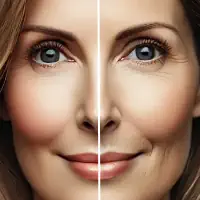
Why are some wrinkles deeper on one side than the other?
The face is not perfectly symmetrical, and we do not make identical expressions on both sides. One eyebrow may rise more, a smile may pull more strongly to one side, or one cheek may have a different shape. That asymmetry can make a line appear earlier or look deeper on one side.
The important point is to distinguish a familiar asymmetry from a new change. If the difference appeared suddenly or is accompanied by weakness, altered sensation or other symptoms, it should not be interpreted as an aesthetic issue and requires medical evaluation.
Can wrinkles appear “all at once”?
Often what changes suddenly is perception. Side lighting in a photograph, weight loss, a period of greater sun exposure, drier skin or simply beginning to look closely at an area can make existing lines seem new. A line may also cross the point at which it no longer disappears completely and begins to remain visible at rest.
If several areas of the face seem to have changed over a short period, assessment should look at the broader context rather than assuming five independent wrinkles suddenly appeared.
What can creams, retinoids and sunscreen actually do?
A good skin-care routine can improve hydration, texture and brightness, and appropriate renewal ingredients may help with fine lines and photoaging in suitable people. Sunscreen is especially important for limiting further damage. That has value even when it does not erase a deep wrinkle.
What a cosmetic product cannot do is selectively stop a strong muscle contraction, reposition tissues that have lost support, or guarantee removal of a deep fold. If a line does not change despite good home care, the dominant mechanism may not be superficial.
Do collagen supplements, massage, gua sha or facial exercises remove wrinkles?
These strategies may be part of personal care, and some people notice modest changes in hydration, swelling or the sensation of firmness. That is not the same as erasing an established wrinkle or correcting a support change.
Facial exercises deserve particular caution: if a line appears precisely because an area contracts repeatedly, creating even more contraction is not automatically a solution. Before adding exercises or devices, it is useful to know whether the mark depends mainly on movement, skin or structure.
How can I prevent wrinkles from becoming more pronounced?
You cannot—and should not—live by avoiding every facial expression. Smiling, raising the eyebrows and moving the mouth are normal. Realistic prevention focuses on skin care, reducing sun exposure, avoiding smoking, and recognizing when a line that used to be purely dynamic begins to remain visible at rest.
If one area has particularly strong movement and that concerns you, an early assessment can help explain the pattern. Seeking a consultation does not oblige you to treat; the conclusion may simply be to observe and continue basic care.
Can wrinkles be removed completely?
It depends on what “remove” means. A line that appears only with expression can be reduced substantially if the movement creating it is reduced. A mark that is already etched into the skin at rest can improve, but the skin retains its own history and structure. An anatomical fold such as the nasolabial fold should not necessarily be viewed as something that must disappear.
A more useful goal is often to soften a line that dominates the expression, prevent it from deepening, or improve tissue quality without erasing the identity of the face.
Is it better to address a wrinkle as soon as it appears, or wait until it is deeper?
There is no mandatory age or moment. If a line appears only with expression, does not bother you and disappears when the face relaxes, there may be no reason to do anything. If it begins to remain at rest or the movement pattern is very strong and concerns you, an earlier assessment can help clarify what is happening.
Waiting also does not mean that later “nothing can be done.” What changes is the composition of the problem: a more established line may involve both movement and skin, so expectations and approach are different.
Can wrinkles be improved without losing expression or looking artificial?
A natural face is not a face without lines. Expression requires movement, and certain transitions are part of normal anatomy. Planning should start with what bothers you and what you want to preserve, not with the idea of making every area of skin completely smooth.
This is especially important on the forehead and with crow’s feet, where movement is an obvious part of expression. It also matters around the mouth, where overcorrecting an area can change how the face looks while speaking or smiling.
Why is there no single treatment for every wrinkle?
Because “wrinkle” describes what we see, but not always the mechanism. When repeated contraction is the dominant factor—as with many upper-face expression lines—the pathway often ends with treatments that act on that movement, and Botox is one of the main options when movement is driving the problem.
When a fixed mark or a change in skin quality predominates, skin-renewal strategies may make more sense. And when a line reflects loss of support or tissue descent, as may happen with marionette lines or the nasolabial fold, assessment should look at structure and support before focusing on the isolated line.
That is why treatment comes at the end of the reasoning process, not at the beginning.
When should a specialist assess my wrinkles?
An assessment is useful when you are not sure whether a line comes from movement, the skin or a deeper change; when several areas have changed together; when you want improvement but are concerned about losing natural expression; or when you have tried different solutions without understanding why the line does not change.
A useful assessment looks at the face both at rest and in motion, identifies which areas truly belong to the same problem and which need different pathways. The first step is not choosing a procedure; it is understanding which wrinkle you are treating and why it formed.
The first step is not choosing a treatment: it is understanding what type of wrinkle you have
A movement line, a mark that remains at rest and a fold related to loss of support may look similar in a photograph, but they do not arise from the same mechanism. Treatment is therefore selected only after identifying what is generating the mark and what result you want to preserve.
When movement is the dominant factor, Botox may be one of the options to consider. When skin or support changes dominate, the pathway may be different. The dedicated pages for forehead lines, crow’s feet, upper-lip lines, marionette lines and the nasolabial fold let you explore the area that actually concerns you before deciding what to do.