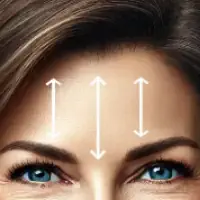
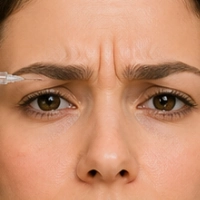
Forehead expression lines begin with normal movement
The forehead folds when we raise the eyebrows. That movement creates horizontal lines and is part of an expressive face. In some people the lines disappear completely at rest; in others they begin to remain visible even without eyebrow movement. That distinction—what appears with expression and what remains at rest—is the first useful piece of information.
This page focuses on horizontal forehead lines. If what you see are lines at the sides of the eyes when you smile, see crow’s feet. If they are vertical lines between the eyebrows when frowning, the specific page is frown lines and it is better not to mix that with horizontal forehead lines.
If you are not yet sure how to classify what you see, return to the general wrinkle guide to first identify which type of line you are looking at.
What you will find on this page
Why does my forehead crease so much when I raise my eyebrows?
Not everyone uses the forehead with the same intensity. Some people raise their eyebrows a lot when speaking, showing surprise, applying makeup or concentrating. The stronger the frontalis muscle contracts, the more the skin folds and the more visible the lines are during expression.
That does not mean you are “making expressions incorrectly.” It simply describes your movement pattern. The important question is whether the lines appear only with that expression or whether repeated folding has already left a mark that remains visible when the face relaxes.
Why do I raise my eyebrows all the time without realizing it?
Some people activate the forehead almost continuously. It may be part of their usual expression; in others, that movement helps keep the eyebrows in a position that feels comfortable and keeps the eye area more open.
That is why it is not enough to look only at the lines. If you feel you need to raise your eyebrows to make the eyes look more open, an assessment should observe the forehead, eyebrows and eyelids in motion before deciding how much movement should be modified.
When does an expression line begin to remain visible with the forehead at rest?
At first, the skin folds when the eyebrows are raised and smooths again when they relax. With repeated movement and progressive skin changes, some lines take longer to disappear. They may initially be visible only in certain lighting and later remain visible at rest.
At that point two components usually coexist: the movement that continues to form the fold and a line that is already present in the skin. Reducing future movement and improving an established line are therefore not exactly the same goal.
Why do I have forehead lines when I am young?
The presence of lines does not by itself mean premature aging. A young person can have a very active frontalis muscle and form deep folds every time the eyebrows are raised while still having skin that smooths almost completely afterwards.
Age matters less than how the line behaves: how much it appears with expression, how much remains at rest, whether it has changed compared with previous years and how much it bothers you. There is no age at which a forehead is “supposed” to be smooth, and visible lines do not create an obligation to treat them.
Why can one line be deeper or one side move differently?
Frontalis contraction is not perfectly symmetrical. One eyebrow may rise more, one area may activate earlier, or the skin may repeatedly fold over the same point. Over time, one line can become established before the others or one side can look more marked.
The difference matters because the goal is not to “make the lines match,” but to understand how each side moves. A new or sudden asymmetry, especially if it appears with other symptoms, requires medical evaluation and should not automatically be attributed to an aesthetic issue.
Are vertical forehead lines the same as frown lines?
No. The horizontal lines discussed on this page appear mainly when the eyebrows are raised. Vertical lines between the eyebrows are created by a different movement, usually frowning or concentrating.
They can coexist, but they follow a different pattern. If your main concern is those vertical lines, see Botox for frown lines. Here we continue to focus only on horizontal forehead lines so the two concerns are not mixed.
How can I help prevent forehead lines from deepening?
Reasonable prevention combines two things: caring for the skin and understanding how much the forehead works. Sun protection helps limit accumulated damage; an appropriate routine can improve texture and fine lines; and avoiding tobacco also protects skin quality. No cream, massage or active ingredient prevents the skin from folding every time the frontalis contracts.
Prevention also does not mean trying not to express yourself. If lines begin to remain visible after movement, or you are concerned about how strongly you raise your eyebrows, an assessment can separate the component caused by movement from the component already established in the skin.
Should I do something when lines appear only with expression, or wait?
There is no mandatory time to act. If the lines appear when you move your forehead and do not bother you, they are part of your expression and do not require aesthetic treatment. If you are concerned about the strength of the movement or notice that a line is beginning to remain at rest, a consultation can help assess how it is evolving.
Waiting also does not automatically make a line irreversible. What can change over time is the addition of a skin component, which changes expectations about how much an established line can be softened.
Can the forehead be softened without looking frozen?
Yes. There is a difference between reducing a movement that deepens lines and aiming for a completely immobile forehead. A natural result does not require eliminating every contraction: many people want to keep raising their eyebrows, showing surprise and having small lines when they make expressions.
The goal should therefore be agreed before treatment. A perfectly smooth forehead at any cost may not fit the expression of the rest of the face. Assessment helps determine how much movement should be preserved for that individual person.
Why is there concern that the eyebrows may drop or the eye area look heavy?
The frontalis muscle helps raise the eyebrows. Some people rely more on that movement to keep their eyebrows in their usual position. If it is modified too much without first observing how the eye area works, the person may perceive the brows as lower or heavier.
That does not mean every forehead treatment will produce that change. It means treatment should not be planned by counting lines in a still photograph: the patient should raise, relax and move the eyebrows so the actual balance can be understood.
What should a specialist assess before treating the forehead?
The forehead should be observed at rest and while the eyebrows are raised, noting which lines appear, which remain, how much each side moves and the baseline eyebrow position. Skin quality and the result the patient wants to preserve also matter.
That examination separates three different questions: how much movement is creating the lines, how much of the mark is already in the skin, and how much movement needs to remain for the expression to still feel like the patient’s own.
A natural-looking forehead is assessed in motion, not by counting lines
When horizontal lines appear mainly because the frontalis contracts strongly, Botox is one option that may be considered to reduce that component. The decision is not to make the forehead immobile, but to reduce the movement that deepens the lines without losing an expression that still feels like your own.
If marks are also visible with the forehead relaxed, skin quality becomes part of the assessment. A reasonable indication therefore comes from seeing how the eyebrows move, which lines remain at rest and what balance that particular forehead needs.
Further reading
You can also read about skin, treatments and medical decision-making in our
medical aesthetics blog.