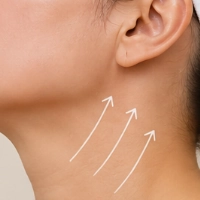
How can I tell if I have facial laxity?
In everyday language, “laxity” is used for almost any face that looks as though it is starting to sag. Medically, it is more useful to separate several components: skin that has lost elasticity, soft tissues that have descended, changes in volume and changes in contour. They can coexist, but they do not mean the same thing.
Common signs include cheeks that appear lower, a less defined jawline, more visual weight in the lower third, skin that folds more easily or the appearance of jowls. A person may have mainly superficial skin laxity or a deeper change in tissue position. That is why “I want to tighten my face” still does not tell us what actually needs to be corrected.
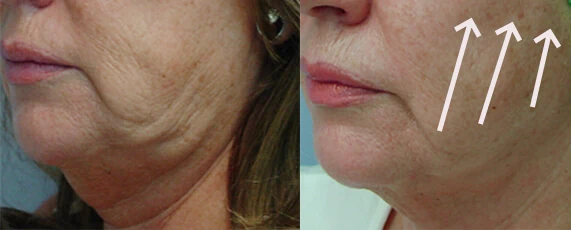
Is facial laxity loose skin, or are the facial tissues moving downward?
It can be one, the other or both. Skin gradually loses some of its elasticity and its ability to adapt to changes underneath. At the same time, the face ages in deeper planes: volume distribution changes and tissue support changes. When these processes combine, the surface may look “loose” even when the problem is not exclusively in the skin.
This distinction matters because improving texture or hydration does not reposition deeper tissues, and adding volume does not automatically correct lax skin. Before doing anything, it is important to understand which component is dominant.
Are there different types or degrees of facial laxity?
We can describe different patterns and levels of severity, but there is no single at-home scale that applies to every face. In some people, the dominant issue is more superficial skin laxity; in others, tissue descent and loss of contour definition play a larger role. It is also common for both components to be present to different degrees.
Calling laxity mild, moderate or marked can help communicate how much the face has changed, but that label alone does not identify which structure is involved. To decide what makes sense, it matters more to know where the laxity is, which component is dominant, and how it relates to that person’s volume and anatomy.
How can I tell whether I have laxity or volume loss?
Volume loss tends to create flatter or hollow areas and new shadows; laxity is more often perceived as descent, folds and loss of definition. Visually, however, they can overlap. When a cheek loses volume and also descends, the midface can look empty above and heavier below.
There is no reliable home test that can determine how much belongs to each component. Pinching the skin, looking at the face while lying down or lifting it with your fingers may show that the contour changes, but it does not tell you which structure is responsible or what should be corrected. If the question is “have I lost volume or has my face sagged?”, that is exactly the kind of question an assessment should answer.
Why does it feel as though my face is falling?
Facial contour depends on the relationship between skin, fat, ligaments, muscles and deeper structures. With age, these layers do not all change in the same way. If midface support decreases and tissues redistribute downward, the transition between cheek and jawline can become less defined.
That is why the jawline can look less sharp even though the bone is “still there.” What changed may be the tissues covering and defining it. In some people laxity dominates; in others there is more localized fat; in others, loss of upper support. A similar outward appearance can therefore have different causes.
What are jowls, and why can they make the face look heavier?
Jowls are the bulging or downward displacement that appears on either side of the jawline and interrupts the smooth facial oval. They are not simply “cheeks” and do not always mean excess fat. They may result from a combination of tissue descent, fat distribution, changes in support and individual anatomy.
If this is the sign that concerns you most, the dedicated jowls page is more precise than discussing laxity in general. Facial laxity is the broader problem; jowls describe a localized manifestation in the lower third of the face.
Can I have facial laxity even if I have very few wrinkles?
Yes. wrinkles and laxity are different phenomena. A person may have relatively smooth skin but lose definition of the facial oval, while another person may have many expression lines with very little tissue descent. Counting wrinkles therefore does not tell us how much laxity is present.
The opposite can also happen: thin or wrinkled skin without major descent. In that situation, the goal should not automatically be framed as “lifting” the face. Identifying the correct problem helps avoid treating one concern as though it were another.
Why do some people develop facial laxity earlier than others?
Inherited anatomy, skin thickness and elasticity, fat distribution, weight changes, sun exposure and the normal aging of deeper structures all play a role. There is no exact age at which facial laxity “starts” for everyone.
A face with a particular structure may show lower-face changes earlier; another may retain a very defined contour and show wrinkles or photoaging first. Genetics influences the pattern, but it does not predict everything and does not mean that two relatives will age in the same way.
Can weight loss leave the face looking saggy?
Substantial weight loss can reduce the volume that previously filled and visually supported certain areas. If the skin does not adapt completely, laxity may become more noticeable. The effect depends on how much weight was lost, how quickly, age, skin elasticity and the previous distribution of facial volume.
That does not mean that regaining weight will necessarily “lift” the face, or that every post-weight-loss change should be corrected by adding volume. First we need to distinguish how much is skin, how much is volume loss and how much is descent.
Can menopause, sun exposure or smoking worsen facial laxity?
The menopausal transition may be accompanied by loss of collagen, hydration and skin elasticity. Chronic sun exposure also damages components of the dermis and can reduce firmness. Smoking is associated with skin aging. All of these factors can influence the quality of the facial envelope.
However, none of them alone explains all facial descent. When pigmentation, texture or uneven tone from sun exposure dominate, it is better to start with the specific concern of skin pigmentation and identify which sign is most important. When the main issue is descent and loss of contour, this page is the more appropriate starting point.
Is a double chin always fat, or can laxity also be involved?
Not every double chin is excess fat. Under the chin there may be fat, skin laxity, neck anatomy, chin position or a combination. Two people with similar photographs can therefore require completely different interpretations.
That is why it is not safe to assume that “reducing fat” will always improve the contour. If laxity is the dominant component, removing volume without considering the skin can even make excess skin more visible. Identifying the main component matters more than the label used for the area.
Why can folds or creases look deeper when the face descends?
Because a fold does not depend only on the skin covering it. When cheek position or volume changes, transitions between facial areas can deepen and create more shadow. Some people then identify the problem as “a fold” when it is actually part of a broader change in facial support.
This distinction matters because trying to erase every line directly can add weight without correcting the cause. On this site, the nasolabial fold has its own concern page because it deserves a specific assessment and should not be reduced to “filling a line.”
Can creams, massage or facial exercises lift a sagging face?
Skin care can improve hydration, barrier function and the surface appearance of the skin, and massage can temporarily change swelling or the sensation of tension. That is different from repositioning deeper tissues that have descended. Likewise, evidence for “facial exercises” as a method capable of reversing structural laxity is limited and does not make them equivalent to correcting tissue support.
That does not make home care useless: well-cared-for skin can look better and tolerate aging better. It simply means expectations should be realistic about which layer is actually being changed.
Does facial laxity worsen over time, and can it be prevented?
Aging continues, so laxity and support changes may become more visible over the years. There is no way to stop that process completely. It does make sense to reduce modifiable factors—especially sun exposure and smoking—maintain a relatively stable weight and care for skin health.
Prevention also does not mean starting procedures very early by default. An intervention only makes sense when there is an identifiable problem, a reasonable expectation and a favorable benefit-risk balance.
Can firmness improve without changing the shape of the face?
In mild or moderate cases, some aspects of firmness and skin quality may improve without aiming to change facial features. But the word “lift” can create very different expectations: improving elasticity is not the same as repositioning several centimeters of tissue.
A responsible consultation therefore needs to translate the wish for “a firmer face” into a concrete goal: better skin, more support, less visual weight in the lower third, better jawline definition or simply a more rested appearance. Each goal has different limits.
When does facial laxity exceed what a non-surgical approach can achieve?
When there is substantial excess skin or marked tissue descent, non-surgical procedures do not produce the same repositioning as surgery. That does not mean they cannot improve anything; it means the goal must be proportional to what each option can realistically do.
A good assessment also helps recognize those limits and avoid repeated treatments that cannot achieve the desired result. In some cases, the right recommendation may be to accept a moderate improvement; in others, to consider an external surgical evaluation.
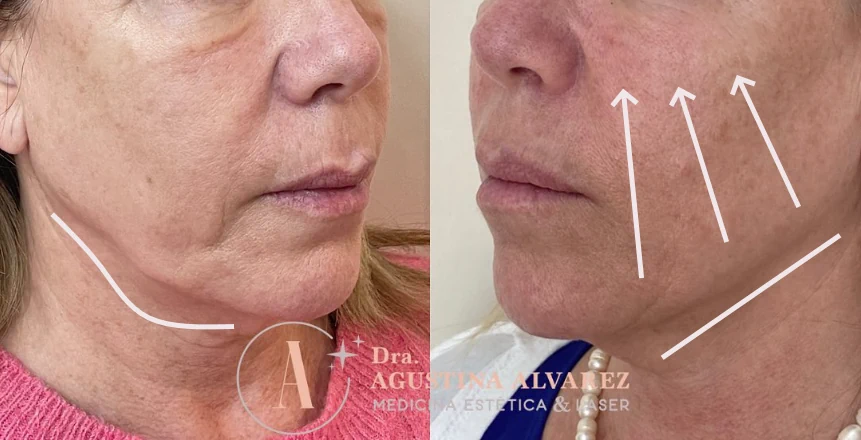
Why is the first step to identify which structure has changed?
Because “laxity” describes what you see, not necessarily the cause. An assessment looks at the skin, volume, tissue descent, jawline, submental area and natural asymmetries. It is also important to know about weight loss, hormonal changes, previous procedures and the result you are hoping for.
The useful conclusion should not be “I need tightening,” but something more precise: which component is producing the descent and how much it is reasonable to improve. Only then does it make sense to choose a strategy.
Once the type of laxity is identified, what can be decided during an assessment?
The assessment can help determine whether the priority is skin quality, firmness, support or contour, or whether the degree of descent requires a different kind of approach. The related options below are possible paths available at the clinic, not an automatic indication based only on a photograph or on the word “laxity.”