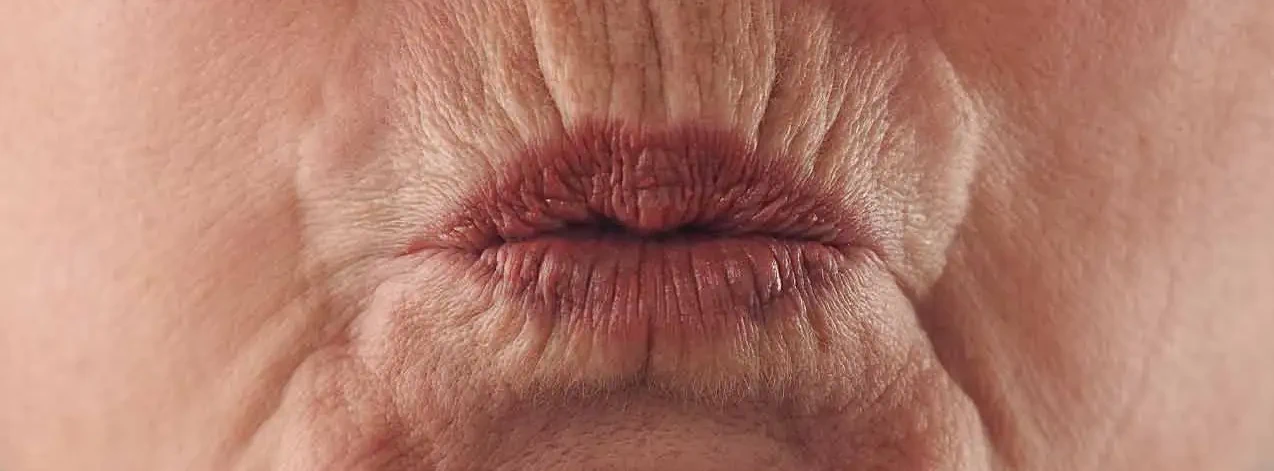
Vertical lines above the upper lip are perioral wrinkles, sometimes called “smoker’s lines”
Many people search for this without knowing what the lines are called: “little lines above the lip,” “wrinkled skin above the mouth,” or “lipstick bleeding into the lines.” The common local term is upper-lip lines and the broader medical term is perioral wrinkles.
This page focuses on that specific area: vertical upper-lip lines and the skin immediately around the mouth. If the concern is that the lip is small or has lost volume, see thin lips. If the line runs downward from the mouth corner, see marionette lines; if it comes from the side of the nose, see the nasolabial fold.
For other facial areas, use the general wrinkle guide.
What you will find on this page
Why do vertical lines appear above the upper lip?
The mouth moves constantly to speak, eat, smile, kiss and purse the lips. That movement folds the perioral skin many times a day. While the skin still recovers its shape well, lines may be visible only during movement; as elasticity changes, some begin to remain.
Skin quality, sun exposure, genetics, smoking and changes in lip support can all add to that movement component. Two people with similar-looking lines may therefore have different dominant mechanisms.
Are these “smoker’s lines”? Why do they appear even if I have never smoked?
The name “smoker’s lines” became common because smoking combines skin damage with repeated pursing of the lips. But smoking is not required: many people with these lines have never smoked.
Perioral movement, sun exposure, genetics and age-related skin changes can produce the same pattern. Having these lines does not allow anyone to infer a person’s habits.
At what age do upper-lip lines begin to appear?
There is no single age. Some people notice fine lines early because of their movement pattern, sun exposure or skin characteristics. In others, they appear later when folds take longer to disappear after facial movement.
More informative than age is the way the lines evolve: whether they appear only when pursing the lips, whether they have begun to remain visible with the mouth relaxed and whether the texture of the area has changed compared with previous years.
What role does sun exposure play in upper-lip lines?
Ultraviolet radiation contributes to photoaging and can reduce skin resilience and elasticity. In an area that folds repeatedly, accumulated damage can make the creases recover less fully and remain more visible.
Sun protection helps limit additional damage, but it does not remove an established line by itself. Its role is preventive and part of overall skin care.
What can change around the mouth during menopause?
During the menopausal transition and after menopause, hydration, elasticity, thickness and overall skin quality can change. In a thin, highly mobile area such as the mouth contour, those changes can make lines that were previously subtle more visible.
This does not mean menopause alone causes upper-lip lines or that every woman develops them. It is one part of the skin context that can combine with movement, sun exposure, genetics and other facial changes.
Do talking, drinking through a straw, kissing or pursing the lips cause these lines?
Those movements contribute because they fold the skin, but it makes no sense to try to live while avoiding normal facial movement. The face is made to express itself. What matters is what happens after the movement: skin that recovers its shape well behaves differently from a line that remains etched in place.
The question should not be “which movement do I need to forbid myself from making?” but how much movement contributes in your case and how much skin quality contributes.
How do I know whether the issue is movement, skin quality or an established line?
Look at the area with the mouth completely relaxed and then make the movement that creates the lines most strongly. If they appear only with movement and disappear afterwards, the dynamic component is important. If they remain visible, there is also a line at rest.
Texture also needs to be assessed: many very fine lines are not the same as a few deep furrows. Photoaged skin is also different from a line whose appearance changes because the lip border has lost definition. Assessment separates these components.
Why does lipstick start bleeding into the lines when it did not before?
Small vertical channels can act as paths along which a more fluid product travels. For many people, this change in how makeup behaves is the first sign that perioral texture has changed.
Changing the formula or application technique may improve how lipstick behaves, but if the channel is already present, that does not explain or correct its cause. It is a useful signal to assess the skin and lip border in more detail.
Do upper-lip lines mean I need to increase lip volume?
No. Thin lips and perioral wrinkles can coexist, but they are different concerns. A person may have good lip volume and pronounced vertical lines; another may have little lip volume without significant perioral lines.
This distinction is especially important when the patient wants to improve the skin but does not want to change the size or shape of the mouth. The presence of a line should not automatically become an indication to enlarge the lips.
Can upper-lip lines be improved without making the mouth look artificial?
Natural expression is one of the main goals in this area because the mouth participates in smiling, speech and facial identity. The result should not start from the idea of “erasing every line” if that requires changing a mouth the patient does not want to alter.
Depending on the dominant component, it may make more sense to soften texture, reduce one dominant fold or prevent a line from becoming deeper. Preserving proportions and movement is part of the decision.
What can I do at home to help keep these lines from becoming more pronounced?
Sun protection helps limit additional damage, and a well-tolerated routine can improve hydration, texture and fine lines. Renewal ingredients may have a role for some skin types, although the area around the mouth can become irritated easily and rapid results should not be pursued at the cost of inflammation.
If you smoke, stopping removes a factor that accelerates skin aging and also has much broader health benefits. Even so, an established line does not necessarily disappear with home care alone: it is important to distinguish how much comes from the skin and how much from movement.
How do I distinguish upper-lip lines, marionette lines and nasolabial folds?
El upper-lip lines are above the lip and around the mouth, mainly vertical. marionette lines run from the mouth corners toward the chin. The nasolabial fold runs from the side of the nose toward the mouth corner.
They can coexist, but they do not share the same mechanism and are not necessarily managed in the same way. The first step is identifying where each line begins and which structures are involved.
What should a specialist assess before recommending anything for perioral lines?
The mouth should be observed at rest and during different movements, along with skin texture and thickness, which lines remain fixed, and the lip border and support. It is also important to know what the patient does not want to change.
The final assessment should answer: does movement predominate? Is there an established skin line? Is there photoaging? Has lip support changed? That classification is more useful than choosing a procedure based only on the label “upper-lip lines.”
Improving upper-lip lines does not mean changing the lip
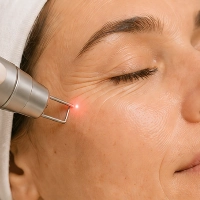
If the lines appear mainly when pursing or projecting the lips, Botox may be one option to consider for reducing that movement component. If the line remains visible at rest and skin quality is the dominant issue, resurfacing approaches such as CO2 laser for wrinkles.
Neither possibility automatically means increasing lip volume. The decision begins by looking at the mouth at rest and in motion, distinguishing which component forms the line and defining what should be improved without altering the shape or expression of the mouth.