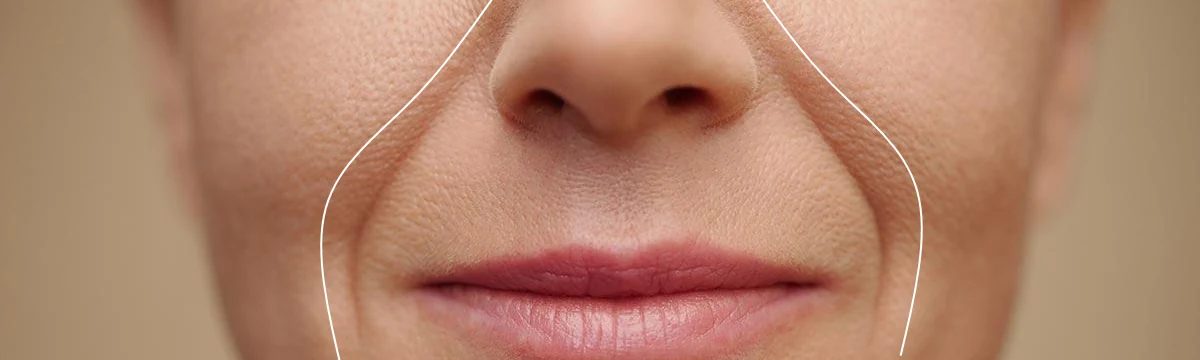
The nasolabial fold is the line that runs from the nose toward the corner of the mouth
The nasolabial fold marks the transition between the cheek and the area around the mouth. It begins near the side of the nose and runs down toward the corner of the mouth. Every face has this transition to some degree, and it usually becomes more visible when smiling.
This page is specifically about that line nose → mouth. If the fold runs down from the corner of the mouth toward the chin, it is a marionette lines; if the lines are vertical above the lip, they are perioral / upper-lip lines.
If you are not yet sure which area you are looking at, the general wrinkle guide can help you map the different areas.
What you will find on this page
Why do nasolabial folds become more pronounced?
There is no single cause. Some people have a defined fold from a young age because of facial shape, cheek projection and the natural distribution of tissue. In others, the fold becomes more visible as midface support changes.
Skin quality affects the surface appearance, but a deep fold may depend much more on the relationship between the cheek and mouth than on an isolated skin wrinkle.
Is it a wrinkle, or a fold caused by changes in the cheek?
That is the central question. A fine line in the skin is not the same as a three-dimensional fold where the cheek forms a small step above the mouth area. A fold that appears only when smiling is also different from one that remains marked at rest.
The fact that the line is where the change is visible does not mean the cause lies inside it. Creams can improve hydration and texture, and massage or gua sha may temporarily change swelling or the sensation of tension, but they do not reposition a cheek when the main problem is loss of support..
Why can I have a pronounced nasolabial fold when I am young?
Because it is a normal anatomical structure and some faces show it more clearly. Bone shape, cheekbone projection, soft-tissue distribution and the way a person smiles can produce a visible fold from an early age.
In a young person, it is especially important to distinguish a feature that has always been present from a recent change. Having a visible fold does not mean it needs correction or that the face has aged prematurely.
Why does it become much more visible when I smile?
Smiling moves the cheek and makes the nasolabial transition more visible. In many people, the fold deepens during expression and softens again at rest. That is part of a moving face.
People usually become concerned when the line is no longer mainly dynamic and remains visible with the face relaxed, or when the cheek seems to cast a heavier shadow over the fold.
Why does it look huge in some photos when I barely notice it in the mirror?
The fold is a three-dimensional transition, and lighting can exaggerate its shadow. A side angle, a close camera or an expression captured at one instant can make it look deeper than it appears in motion.
That is why a single photograph should not determine treatment. It is more useful to observe the face in different expressions and, if you want to understand what has really changed, compare it with your own photographs from previous years.
Why can the fold make me look more tired or older?
A deeper shadow between the cheek and mouth can make the midface look less continuous or heavier. For some people, that reads visually as a tired or older face even though the concern they point to is simply “a line.”
That is why it matters to ask what the person actually wants to improve: erasing a line, restoring a cheek that feels less supported, or looking more like they did a few years ago are not exactly the same goal.
Why can it deepen over time or after weight loss?
Significant weight changes can alter facial volume and make a transition that was previously subtle more visible. Over time, support, tissue position and skin quality can also change. None of these processes occurs in exactly the same way in every face.
There is therefore no obligation to treat the fold before it is “too late.” If it does not bother you, it does not need aesthetic treatment. If it has changed, understanding what happened in the midface is more useful than focusing only on the depth of the line.
Can the nasolabial fold be eliminated completely?
The starting point should not be that every transition between the cheek and mouth has to disappear. The fold is part of normal anatomy and facial expression, even in young faces.
When it is bothersome, a reasonable goal is usually to make it visually less prominent or restore a more harmonious midface. Completely erasing a natural line does not necessarily make a face look younger.
Why do I not recommend filling the fold directly?
Many people arrive asking for “nasolabial fold filler.” Facial fillers have their own indications and can be useful when the actual goal requires adding volume or correcting a specific structure. That does not mean product should automatically be placed directly into this fold.
With nasolabial folds, the line is often the visible consequence of changes occurring above it: loss of midface support, descent of the cheek or a different distribution of volume. Adding product inside the fold can add weight without correcting the cause. My approach is therefore to assess the midface first rather than use direct filler as an automatic response to the line.
What should a specialist assess to understand what is making my fold more visible?
The fold should be observed at rest and while smiling, including how much the cheek contributes, whether one side casts more shadow than the other, skin quality, weight changes and which part of the face has changed compared with previous years.
The goal also matters. “I want to erase the line,” “I want to look less tired,” and “I feel my cheek has dropped” can lead to different assessments even when the person points to exactly the same place.
You cannot understand a nasolabial fold by looking only at the line
When assessment shows that the fold is deepening because the midface has lost support and structural quality, Sculptra is one option that may be considered within our approach. The goal is to address the context that makes the nose-to-mouth transition look heavier, not to fill the fold reflexively.
If the fold is mainly anatomical, appears primarily when smiling or has a predominantly superficial component, the decision may be different. That is why the cheek, the midface and the way that face has changed over time tell us more than the depth of a single line.
Further reading
You can also read about skin, treatments and medical decision-making in our
medical aesthetics blog.