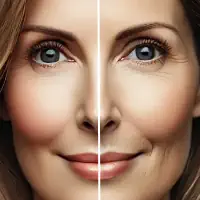
Marionette lines are the folds that run from the corners of the mouth toward the chin
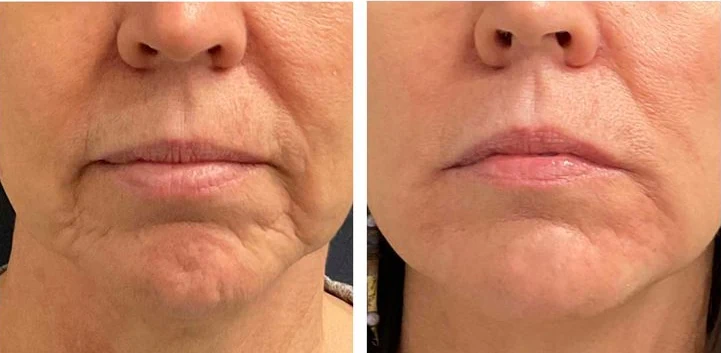
Marionette lines appear below the corners of the mouth and run downward toward the chin. They can create a shadow that makes the mouth look more downturned or the face appear sad, tired or angry even when the person does not feel that way.
This page is specifically about that pathway mouth corner → chin. It is not the same as the nasolabial fold, which runs from the nose toward the mouth, or upper-lip / perioral lines, which are vertical lines around the lips.
If you are not yet sure which fold you are looking at, go back to the general wrinkle guide to identify the type of fold more clearly.
What you will find on this page
Why do marionette lines appear?
They are not usually explained by a single cause. In some faces, an anatomical shadow predominates; in others, support in the lower face changes, tissues descend or the mouth corner begins to look less supported. Skin quality can make the fold more visible, but it is not always the primary cause.
That is why “I have a line next to my mouth” is not enough information to choose a treatment. The place where the line is visible may be the consequence of changes occurring around and above it.
Why do the corners of my mouth look like they point downward even when I am not sad?
The position of the mouth corner depends on the balance between anatomy, movement and tissue support. When the side of the mouth loses support or a downward shadow appears, the expression can read as sadder or more tired.
That visual impression does not necessarily mean that the mouth corner has “dropped” because of one single structure. It is useful to look at the mouth at rest, while smiling and during other expressions before attributing everything to the line.
Is a marionette line the same as a downturned mouth corner?
Not exactly. A marionette line describes the fold or shadow that runs from the mouth corner toward the chin. A downturned mouth corner describes the position of the corner itself. They can appear together, but one does not require the other to be present to the same degree.
This distinction matters because a superficial line can draw attention even when the mouth has barely changed position, while a clearly downturned mouth corner requires assessment of lower-face support. The goal should not be to erase an isolated line if what is changing is the overall appearance of the mouth.
Is the line a skin wrinkle, or is the lower face descending?
Both components can be present. A superficial skin line is not the same as a mouth corner that descends because lower-face support has changed. In the second situation, the shadow seen in the line is more a consequence than the whole problem.
Creams can improve hydration and texture, and massage or gua sha can temporarily change swelling or a sensation of tension, but they do not reposition lower-face tissues by themselves. If the sad-looking expression persists at rest, the question is no longer what product to apply over the line but which structure is providing less support to that mouth corner.
Can I have marionette lines when I am young even if I do not have other wrinkles?
Yes. Marionette lines do not depend only on skin aging. The shape of the chin and jaw, the natural position of the mouth corners and the way lower-face tissues are distributed can make this shadow appear before other facial lines.
In a young person, the most useful question is whether that shape has always been present or whether the mouth corner has changed compared with previous years. A stable anatomical feature does not mean there is tissue descent that must be corrected; a progressive change, on the other hand, calls for assessment of support, volume and tissue position.
That is why the mouth can look more downturned even when the forehead, eyes and skin in general have few lines. This area has its own structural logic and should not be judged by the total number of wrinkles on the face.
Why can they become more visible over time or after weight loss?
Changes in the lower face do not have one single cause. Over time, tissue support can decrease and a mouth corner that previously looked more horizontal can begin to cast a downward shadow. Significant weight loss can also change facial volume and make a previously subtle fold more visible.
This does not mean every line will worsen or that weight loss “causes” marionette lines. What matters is reconstructing what changed in that specific face and whether the line is superficial or part of broader tissue descent.
Why is it not a good idea to automatically think about filling the line?
Because a marionette line can be where loss of support becomes visible, not an isolated hollow that needs volume inside the fold. Adding product directly without understanding the structure can add weight to an area that already looks descended.
The useful question is not how much product can be placed into the line, but why the mouth corner looks more downturned and how much of the change depends on lower-face support. That is why I do not propose direct filling of the fold as an automatic response.
How do I distinguish marionette lines from nasolabial folds and upper-lip lines?
Marionette lines start at the corner of the mouth and run toward the chin. The nasolabial fold runs from the side of the nose toward the mouth corner. upper-lip / perioral lines are vertical lines above the upper lip.
All three can coexist, but they do not describe the same problem. Here we are talking only about the fold or shadow that begins at the mouth corner and runs downward.
What should a specialist assess before deciding what to do?
The mouth corner should be observed at rest and in motion, together with lower-face support, its relationship with the cheek and jaw, skin quality and asymmetries. It also matters whether the patient wants to soften a shadow, regain a less sad-looking expression or simply understand a recent change.
The assessment should determine whether the line is superficial, whether descent predominates or whether both are present. Only then does it make sense to decide which treatment may help.
If the mouth corner looks lower, the key is understanding what has lost support
When a marionette line is part of a loss of support and structural quality in the lower face, Sculptra is one option that may be considered within our approach. The intention is not to fill the fold, but to work on support when that is truly the cause of the downward appearance.
If a superficial line, stable anatomy or another mechanism predominates, the decision changes. The mouth corner, jaw and lower face should explain the indication; treatment should not be chosen simply because a visible line exists.
Further reading
You can also read about skin, treatments and medical decision-making in our
medical aesthetics blog.