How can I tell whether a facial dark patch looks like melasma?
Melasma usually appears as brown or gray-brown areas on the face, rather than as one isolated round spot. It is often fairly symmetrical: both cheeks, the forehead, the central face or the area above the upper lip may be pigmented.
That pattern is informative, but diagnosis does not depend on color alone. It also matters when it began, whether it coincided with pregnancy or hormonal changes, how much it varies with exposure, and whether there have already been periods of improvement followed by new recurrences.
Why does melasma often appear on the cheeks, forehead or central face?
Melasma has fairly characteristic patterns of facial distribution. It may predominate in the central face, on the cheeks or, less often, along the jawline. The combination of location + symmetry + evolution over time provides a strong clue.
Symmetry also helps distinguish melasma from many focal spots. A single isolated lesion on one side of the face raises a different initial question from two pigmented areas that appear in a similar way on both sides.
Can a dark “moustache-like” patch above the upper lip be melasma?
Yes. The upper lip is one of the areas where melasma can appear, and it may look like a shadow or a “moustache.” However, location alone is not enough to diagnose it.
Pigmentation can also occur after irritation, hair removal, dermatitis or other processes. It is therefore useful to ask whether the area darkened gradually, whether there is also pigmentation on the cheeks or forehead, and whether it changes with the seasons.
How can melasma be distinguished from lentigines or sun spots?
solar lentigines are usually focal spots: they can be identified one by one and tend to appear on sun-exposed skin. Melasma is usually broader, forms patches and often follows a symmetrical facial distribution.
Their behavior over time is also different. Melasma tends to darken in response to certain triggers and to recur. Lentigines are more closely related to accumulated sun damage and remain as individual lesions. If you are still not sure which pattern you are describing, you can return to the skin pigmentationoverview.
Why can melasma appear during pregnancy?
Pregnancy produces significant hormonal changes, and in some predisposed people it can coincide with the onset of melasma. This is why melasma has historically also been called the “mask of pregnancy.” It does not mean that every pregnant woman develops melasma or that every dark spot during pregnancy is melasma.
After pregnancy, pigmentation may fade in some people but persist in others. Identifying a trigger does not allow us to predict with certainty how long the condition will last.
Can melasma appear without pregnancy or without taking oral contraceptives?
Yes. Hormonal factors are important, but they are not the only explanation. Genetic predisposition and exposure to ultraviolet radiation and visible light also play a role. Some people develop melasma without being able to identify any specific hormonal change at the beginning.
That is why searching for one single cause can be frustrating. In many cases there is an underlying predisposition on which several triggers act, and the combination differs from one person to another.
Why does sun exposure darken melasma so much?
Ultraviolet radiation stimulates pigmentation and is one of the most important triggers of melasma. Visible light can also worsen it in some skin types. Melasma can therefore react to repeated everyday exposure that a person may not perceive as “sunbathing.”
This helps explain why pigmentation that had been under control can become noticeable again after weeks or months of greater exposure.
Why can melasma worsen even when I use sunscreen?
Because photoprotection reduces one trigger but does not eliminate every factor involved in melasma. The amount applied, whether it is reapplied, cumulative exposure and visible light all matter. Individual predisposition and hormonal factors may also remain active.
That does not mean sunscreen is ineffective. It means melasma is multifactorial and one measure rarely explains its entire course.
Can heat or irritation worsen melasma?
Many people notice changes after periods of heat or irritation. In practice, the most important point is that inflaming the skin can add post-inflammatory pigmentation and make the overall tone look worse, even if that additional pigment is not strictly part of the melasma itself.
That is why skin with melasma does not benefit from trying to lighten it faster at the cost of irritation. If a product or procedure leaves the skin red or sensitive for a prolonged period, that information matters.
Why can melasma look better in winter and darken again in summer?
This pattern is common because environmental exposure changes. During months with lower radiation, some people notice less contrast. When exposure increases again, the pattern may become more visible.
This is different from thinking of melasma as a spot that “disappeared and came back.” The predisposition often remains even during periods when the pigmentation is much less noticeable.
What changes in melasma management during summer?
In summer, controlling everyday exposure becomes even more important: broad-spectrum photoprotection applied properly and reapplied, shade, a hat, and avoiding persistent skin irritation are especially relevant. In some people, protection against visible light with tinted sunscreens may also be considered.
What does not change is the central principle: more intensity does not mean better management. If the skin is tanned, inflamed or highly reactive, the plan may need to be adapted rather than continued exactly as it would be at another time of year.
Why does melasma fade and then return?
Because in many people melasma is a chronic and recurrent condition. The contrast can improve substantially without eliminating that skin’s tendency to pigment again in response to certain triggers.
A recurrence does not necessarily mean that everything done before failed. It is important to look at how much it improved, how long it remained stable, what changed before it returned, and whether new factors were added. A realistic goal usually includes both improvement and maintenance.
How is melasma treated: can it be cured permanently, or is it managed over time?
It is not appropriate to promise that melasma can be eliminated forever. In some people it can fade substantially and become almost imperceptible; in others it persists for years and recurs.
Management is usually individualized and combined: controlling triggers, protecting the skin barrier and choosing interventions according to skin type, history and previous response. It is more useful to think in terms of control, stability and lower contrast than to promise “permanent removal.”
Can melasma get worse if I try to lighten it too quickly?
Yes. An overly irritating strategy can worsen the final appearance. Inflammation can stimulate additional pigment, and some skin types develop post-inflammatory hyperpigmentation very easily.
This is especially relevant when someone keeps adding products or procedures because “nothing works fast enough.” If the lightening process leaves the skin persistently inflamed, the approach should be reconsidered rather than intensified.
Why does melasma require more caution than other dark spots when considering laser treatment?
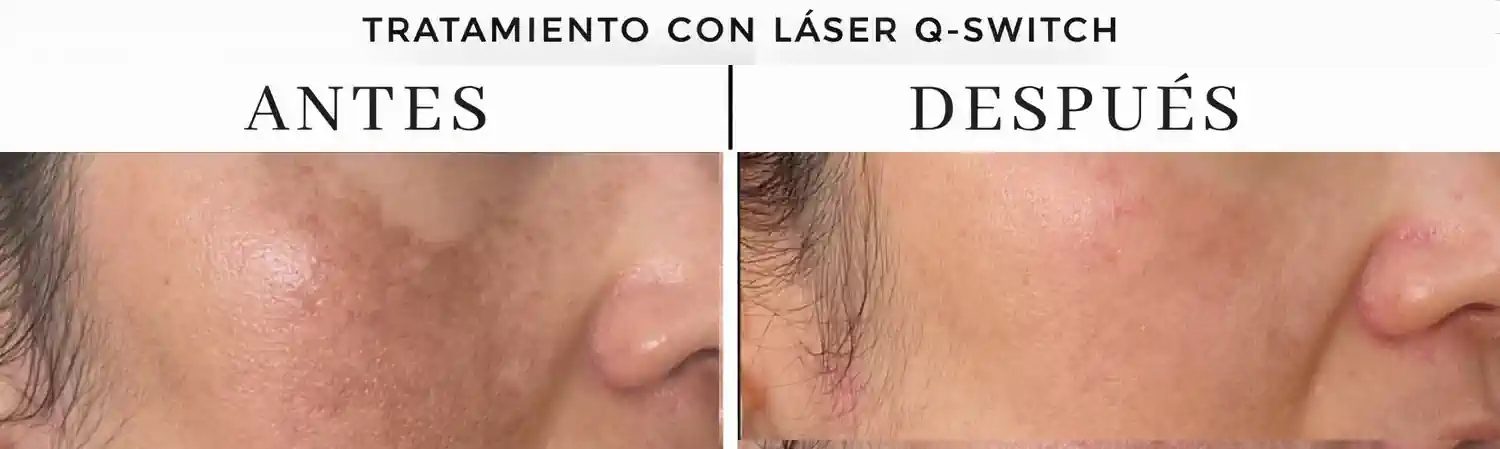
Because melasma is not an isolated pigmented lesion that can simply be “erased.” It is a condition with a tendency to reactivate. Lasers and other energy-based devices may have a role in selected strategies, but an overly intense intervention can cause inflammation and pigment changes that complicate the condition.
The question should therefore not be “which laser removes melasma?”, but “does using an energy-based treatment make sense in my case, for what purpose and at what point?”. When a pigment-specific technology is being considered, one option that may be discussed in selected cases is Q-Switch laser.
The fact that this option exists does not mean that every person with melasma should receive it. The value lies in selecting the right patient, timing and expectations.
Why can two women with melasma have completely different courses?
Because melasma is not identical in every person. Skin phototype, genetic predisposition, hormonal context, intensity of exposure, distribution of pigmentation, skin sensitivity and the tendency to develop pigment after inflammation all vary.
Previous history also matters: someone with a recent first episode is not in the same situation as someone with years of recurrence and multiple attempts at lightening. This variability is one reason universal answers are rarely useful.
What can be learned from a photograph, and what is useful to observe before a consultation?
A photograph can show a compatible distribution, but it cannot tell the whole story. It does not accurately show how much the pigment changes between seasons, what happened during pregnancy, which medications are being used, whether there was previous irritation or how the skin reacted to different triggers.
Before a consultation, it helps to remember when it began, whether it coincided with hormonal changes, which areas appeared first, whether the pattern is similar on both sides, when it darkens, what has irritated it, and whether there are also individual spots that look different from the broader patch.
When is it worth seeking an assessment, and what should the first consultation clarify?
An assessment is useful when you are not sure whether the condition is actually melasma, when pigmentation is increasing, keeps returning, the skin has become irritated by attempts to lighten it, or different types of spots are present on the same face.
The first assessment should answer: is the pattern compatible with melasma?, which factors seem to be maintaining it?, is there post-inflammatory pigmentation or are lentigines mixed in?, is there any individual lesion that needs a specific dermatologic evaluation?
Only then does it make sense to define a plan. If the discussion moves toward pigment-targeting technologies, you can read how Q-Switch works and why its indication must be individualized.
The fact that a technology exists does not mean it is indicated for your melasma
This warning is especially important in melasma. A pigment-targeting technology may have a role in selected cases, but it should not be interpreted as an automatic solution. Indication depends on skin phototype, how active the melasma is, exposure, skin sensitivity and the history of recurrence.
If, after assessing those factors, it makes sense to discuss a specific technology, the next step in this pathway is Q-Switch. The card below explains that option; it does not mean that every person with melasma should receive it.